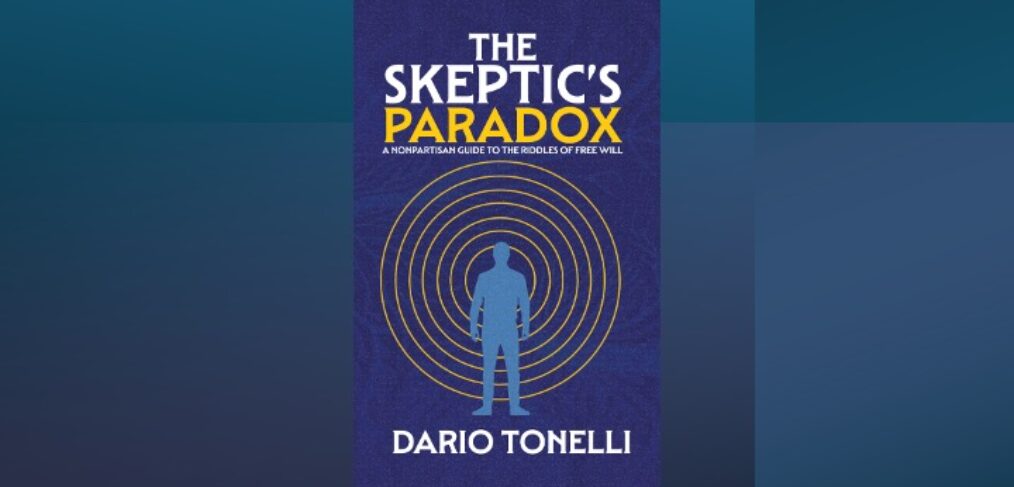
The Skeptic’s Paradox: A Review
I’d never given free will much thought. I make choices all the time, and I’ve felt strongly that those choices are mine. But The Skeptic’s Paradox gave me a lot to think about. As soon as I began reading it, I knew it was going to be right up my alley for exploring what it means to live a meaningful life. Dario Tonelli doesn’t write from a lofty academic tower; he writes from a place of curiosity, of wrestling with the elements of life that we all deal with—freedom, choice, uncertainty—and what it means to live a meaningful life in a world where certainty is never guaranteed.
Tonelli presents the jarring idea that we might be “robots made of meat and neurons.” That idea hits hard. But rather than casting it in a negative light, the author leads us to hope: the very act of choosing feels real because it is real—at least to us. That sense of ownership, even when logic tries to deny it, becomes a reminder that meaning isn’t always in grand certainties. It exists in the moment when we choose.
Tonelli breaks freedom down into five distinct types—intentional, moral, libertarian, stochastic, and metaphysical. The key insight here is how these ideas help us see how many kinds of freedom we already have. For example, there’s the freedom to think and the freedom from coercion. Recognizing these freedoms invites us to live with more clarity: we might not have ultimate freedom (free will), but we have meaningful freedom in everyday choices. That lands right in sync with the idea of living a life that doesn’t feel random or passive.
One of the more beautiful chapters, “Time Loops and Second Tries,” opens up the human side of philosophical puzzles—regret, replaying our life in our minds, the wish to go back and do things differently. Tonelli suggests that even if determinism holds true, the experience of choice is still authentic. That resonated with me because it affirms something I often try to express: meaning isn’t erased just because the universe might feel predetermined. Instead, what matters is how we live—how we act. It’s a call to embrace our power to respond, not just exist.
Tonelli also taps into the dark side—the idea that our biology, trauma, and circumstances might shape us more than we like. He explores how history, society, and hidden forces can drive our most agonizing moments. Tonelli refers to the “inherent, unchanging nature, separate from the constellation of circumstances that act upon them.” This theme is similar to the “core self” I often refer to in my writing. You have not only your core self (or inherent nature), but also the life you lived and the condition you’re in. You can’t just dismiss or replace those elements, but it’s important to keep in mind that they don’t dictate who you are and what you do; instead, they influence who you are and what you do.
Later, when he brings in AI, self-driving cars, and large language models, Tonelli reminds us that old questions become new again. What does free will mean in an age where machine intelligence can predict choices? His idea of “derivative free will”—freedom grounded in conscious reflection rather than supernatural exemption—feels like a conversation starter. For creators and thinkers, it opens the door to exploring meaning in our technology-infused era.
What made The Skeptic’s Paradox feel personally meaningful is the voice behind it. Tonelli isn’t trying to impress with jargon or posturing. He writes as someone who’s genuinely trying to understand. One of my favorite quotes from the book is,
I have done my best to stay away from the fight. Rather than arguing for a specific position, my goal so far has been focused on clarity: understanding what separates the different perspectives, and what would be required for each vision to hold true.
This perspective is based on an ideal that I try very hard to live up to, and one that, if adopted by more with respect to the crucial issues of our time, would result in a much more civilized and evolved society.
In the end, the book frames the “paradox” not as a trap, but as a mirror—one that shows us what it is to live: actively, aware, responsibly. If meaning were a destination, Tonelli suggests it’s actually the journey of choosing itself: choosing to act, choosing to reflect, choosing to accept limitations but still show up anyway.
The Skeptic’s Paradox is incredibly relevant now. As someone living the idea that expression matters, this book affirms something I believe: meaning doesn’t stem from certainty. It springs from the reflection, the choice, or the act. It’s living with awareness in a world that asks us to dance between freedom and fate.
If I were to sum it up: this is a book for people who refuse to settle—for those of us who look for substance beyond surface, who want to feel that our choices matter even when the easy narrative says they don’t. It’s generous, thoughtful, quietly hopeful, and full of the very human questions that drive meaningful living.
~~~
Quotations and references in this review are used under fair-use provisions for criticism and commentary. No part of the book is reproduced beyond what is necessary to support that discussion. All copyrights are retained by the original author and publisher.
~~~
To learn more, go to https://www.armoganpress.com/the-skeptics-paradox