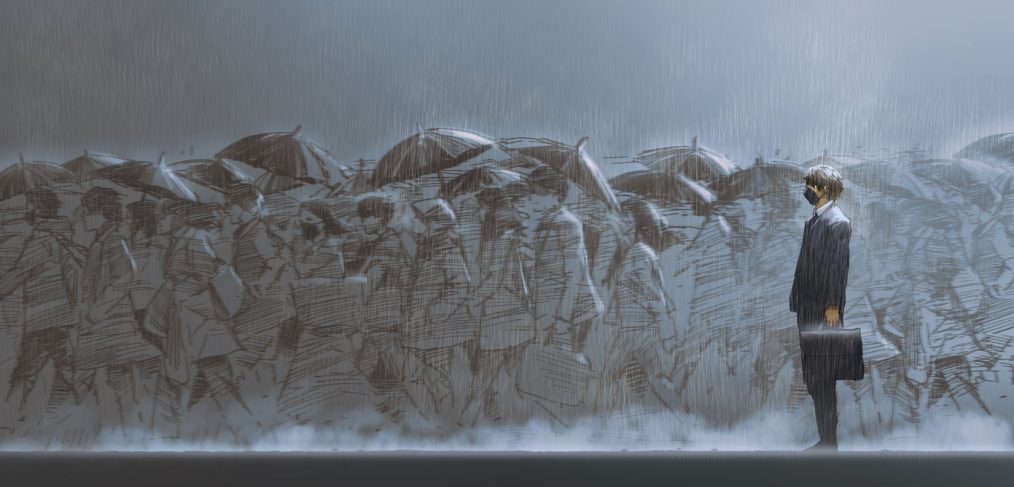
People-balance. Alone in a crowd

People Balance—Solitude and the Need for Human Connection

Some people lead solitary lives—some by choice, others not. Most of us desire a certain level of human contact in our lives. When we don’t have it, we experience a growing yearning, which can become quite urgent if our solitude goes on for too long. The forced solitude experienced by many during the pandemic[1] is resulting in many people feeling this sense of urgency and with no outlet. Days continue to stream by. They may have a periodic video call for work or with family, but ultimately, they’re alone, and they’ve been alone. When we’re faced with solitude, we look for opportunities for any human connection. A quick chat with a server at a restaurant, passing the time with a fellow shopper while standing in line, or some small talk in passing with a neighbor can all be lifelines when we’re feeling truly alone. But we can also feel overwhelmed when we are faced with too much interaction—we feel a need for some solitude. Like anything else in life, balance is key.

Read More
Self Cues

Regular Reflection—Taking Notice of Your Self-Signals

You are receiving regular communications…  from yourself. Many of the messages are ignored, like so many unread emails in your inbox, but they are all delivered. The messages come from your brain, your body, your energy, and your spirit. Everyone notices the big ones, such as injuries, heartache, or fatigue, but there are so many more that may go completely unnoticed. The nuances of your body, mind, and spirit are there for you, and you only need to pay attention and become aware of them.

Read More
Tragedy and Trauma

When the Bottom Falls Out—Dealing With the Aftermath

That was it, the final straw. I thought it couldn’t get any worse, but then there it was—the arrow into my heart. I have no idea how I’m going to go on. I crumple into a fetal position and lose all control. After a time—could have been an hour, could have been several hours—I come back to the world, but it is not the place I left. Nothing is real; it all exists beyond a curtain of pain. I move through the world, but I’m not of it. I try to reenter my life, but my will is gone, and I collapse again. It’s done. I’m done. I have no idea how I’m going to get through this.

Many of us have been there. A catastrophic event that alters our reality and strips away our capacity for joy. How do you move on from that kind of pain? How do you cross the chasm back to the living? You may just want to die—to end the pain. You may even think about ways this might be done. When tragedy happens, it can feel as if your whole world is gone and nothing that’s left in the world could possibly replace it. Everything, from now on, will be inadequate, unwanted, and painful to bear. Everything that remains is only a reminder of what is gone.

Read More
Fluid Identity

Fluid Identity—The Selves We Become

Your life can take twists and turns, and no two days are the same. But at the end of the day, you are still just you, right? Yes and no. Each of us has personas we adopt depending on the context. In a professional setting, you might be more serious and no-nonsense. With your kids, you might adopt a supportive, empathetic personality. When you’re with people you love, you become more attentive and generous. But ultimately, deep down, there’s the version of you in each of these personas—and getting to know that core self is a key to living a genuine life.

Read More
Civil Living

New Release: Civil Living

Today, I’m honored to share something that’s been years in the making: the publication of my book, Civil Living: Finding Civility In Society, In Our Interactions, and Within Ourselves (link). Civil Living is a series of essays that represent a deep and ongoing exploration of how we live, relate, and show up in a world that often feels anything but civil.

Read More