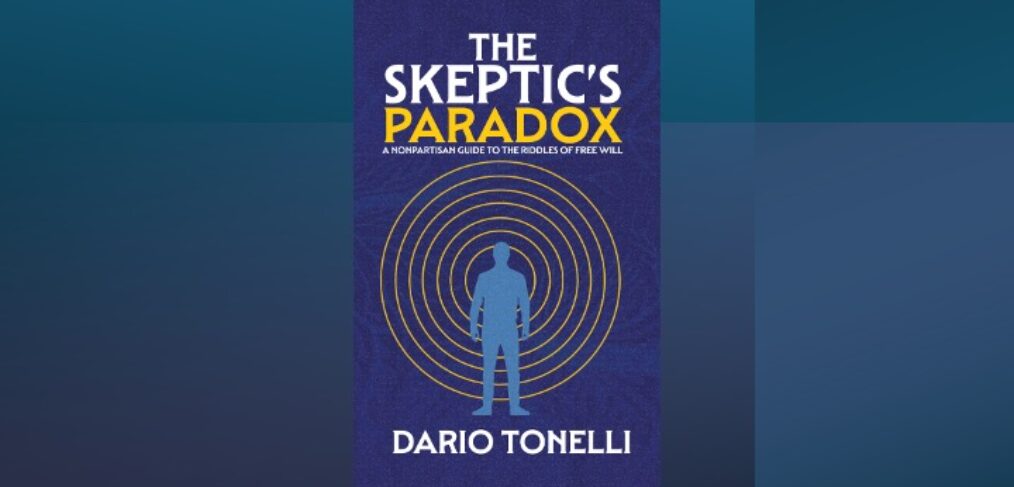
I’d never given free will much thought. I make choices all the time, and I’ve felt strongly that those choices are mine. But The Skeptic’s Paradox gave me a lot to think about. As soon as I began reading it, I knew it was going to be right up my alley for exploring what it means to live a meaningful life. Dario Tonelli doesn’t write from a lofty academic tower; he writes from a place of curiosity, of wrestling with the elements of life that we all deal with—freedom, choice, uncertainty—and what it means to live a meaningful life in a world where certainty is never guaranteed.
Some moments in life are truly special. You experience them as if in a dream, and you keep them in a sacred place in your heart and your memory. Over time, they may become the stuff of personal legend—the experiences that shaped who you are or had an overwhelming emotional impact. These times might include falling in love—and realizing that love is requited. It might be the birth of a child, when everything else becomes a lower priority. It may be a professional breakthrough when your work starts to make a meaningful impact. Whatever it is, the moment in time can be magical, something outside of the realm of the everyday.
There’s always a grain of truth to anything you say. It may not be in the specific words, but the emotions behind those words are likely genuine. You can’t control your feelings, but your actions are entirely in your control. The trick is discerning what actions are appropriate in different emotional contexts. Saying something you don’t mean is a common outcome of an intense emotional state. You may later look back and find it hard to believe that those words actually came out of your mouth. Rather than feeling regret and anxiety about what you said, it is healthier to explore what you were feeling at the time and, if appropriate, discuss what you said with who you said it.
I’ve seen a lot of examples of hypocrisy in recent years—people preaching about ideals then completely failing, in their words and actions, to live up to those ideals. Of course, none of us is perfect. Failing to live up to your vision for yourself and your life is not inherently hypocritical, and it’s good to have aspirational ideals—ideals you hope and plan to live up to. It’s entirely different to espouse an ideal and live your life completely contrary to it because it’s convenient or beneficial.
When something ends—a relationship, a passion, a job—we often characterize the experience as a failure. It may have had periods where it was magical and unique, but we emphasize that it is over and how painful that is. Instead of focusing on the wonderful experiences and special memories, we only think about the end and the pain and regret that come with it. It’s important to remember that everything will eventually end, and with the proper perspective, you can make the ending as meaningful as the experience itself.