The old story of a genie in a bottle granting three wishes might seem like a dream come true, but it isn’t obvious to most what those wishes might be or if they would make their life or the world better. Wishing for something different than what you have is a risky venture. For many, there are heartaches and challenges that a wish, if granted, might resolve, but then they would be faced with a question of the greater good. They would have to decide whether the wish should have been used for the world at large rather than fixing their own lives. Fundamentally, the idea that a change will make your life better is also questionable. Each of us makes what we can with the life we are given, and of course, more money, the absence of disease, and the removal of heartache would make anyone’s life marginally better. However, dealing with those challenges is part of life and makes us who we are.

There’s a lot of talk of courage these days. In challenging times, it takes courage to face new risks, to be a force for change, and to stand up to oppression. If your life has been relatively free from risk and danger, suddenly having to find courage can be harrowing. But if you can: a) identify what you fear and why it’s scary to you, and b) explore what courage means to you, you may find courage you didn’t know you had. Some must find courage because they have no other choice, while others can see a context where courage is needed and must decide whether they have the courage and the conviction they need to test it. We all have some measure of courage, and we’ll invariably face situations in which we have to draw on it.
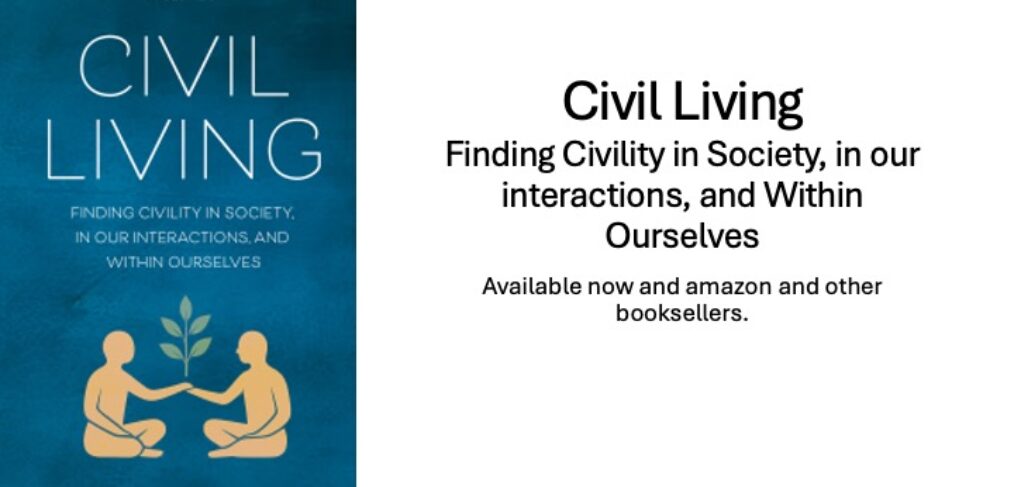
Today, I’m honored to share something that’s been years in the making: the publication of my book, Civil Living: Finding Civility In Society, In Our Interactions, and Within Ourselves (link). Civil Living is a series of essays that represent a deep and ongoing exploration of how we live, relate, and show up in a world that often feels anything but civil.
What are the ingredients of a meaningful life? The simple answer is finding something personally meaningful to you. But, of course, it’s not that simple. It’s vital to understand how endeavors are meaningful to you. What do they give you? How do they make you feel? There are several ways to consider this. One is that an activity fills you with pride and makes you feel good about yourself and how you spend your time. Another is having a positive impact on the world and making a difference. A third is discovery or developing a deeper understanding of something. A meaningful life may be related to your career, a hobby, or how you interact with people. There are many ways to find meaning in your life.
There’s always a grain of truth to anything you say. It may not be in the specific words, but the emotions behind those words are likely genuine. You can’t control your feelings, but your actions are entirely in your control. The trick is discerning what actions are appropriate in different emotional contexts. Saying something you don’t mean is a common outcome of an intense emotional state. You may later look back and find it hard to believe that those words actually came out of your mouth. Rather than feeling regret and anxiety about what you said, it is healthier to explore what you were feeling at the time and, if appropriate, discuss what you said with who you said it.